HOW CINEMA PRINCIPLES HELP CREATE DIGITAL PRODUCTS FOR BUSINESS
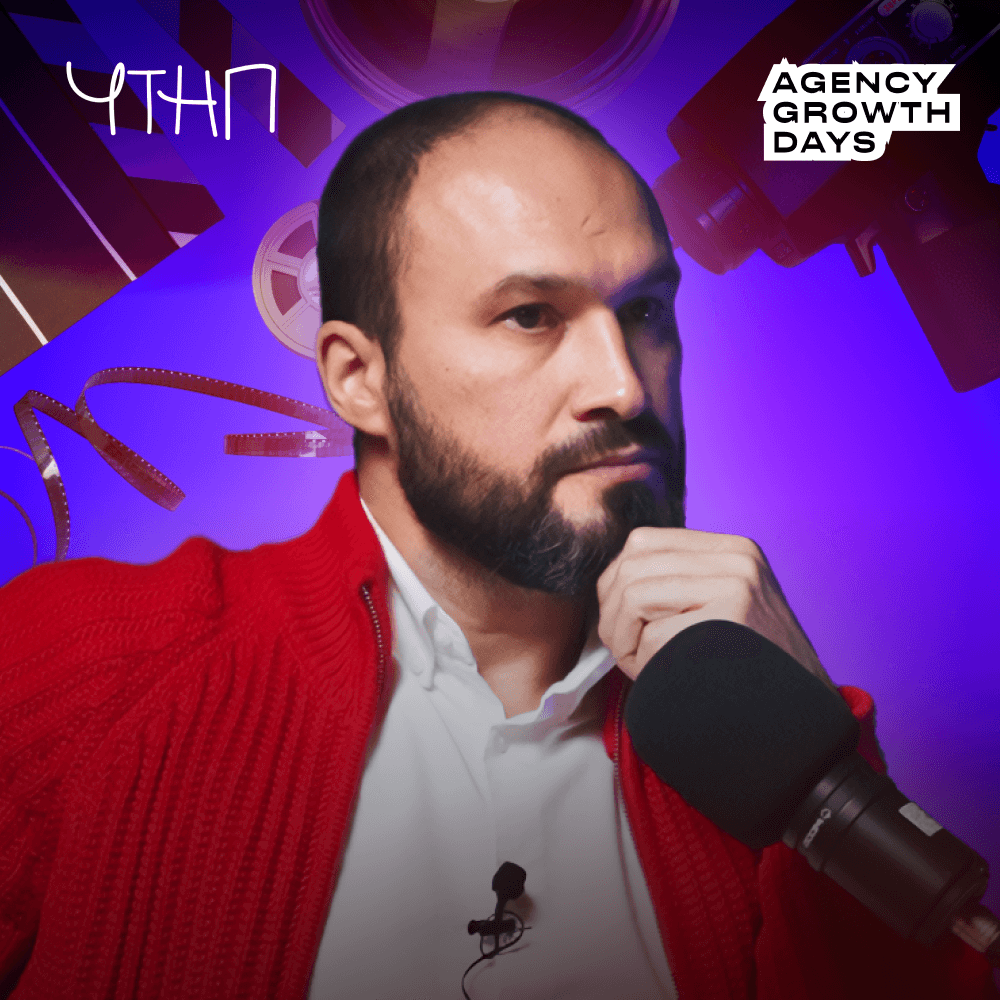
The guest of the new episode is Vadim Mityakin—a methodologist, entrepreneur with over 25 years of experience in creating digital products, a producer for companies, and the author of The Paranoiac’s Method, a book dedicated to the technology of product development. Doubletapp CEO Sergey Anchutin discussed with him why IT projects need producers, how to make a team assembled specifically for a project effective (and why it's worth assembling one at all), how much you can earn in project design, and why IT products and TV series should follow the same principles. We've supplemented the text with excerpts from The Paranoiac’s Method for those who want to dive deeper into the topic and immediately start applying the methodology in work or life.

Author:
Svetlana Prokhorova
Category:
articles
Publication date:
“COMPANIES OFTEN NEED NEW BLOOD FROM OUTSIDE”
How did you end up doing what you do now?
I’ve been in business for about 20 years. I used to run a company specializing in custom product development. But for the last ten years, I’ve worked independently as a specialist and market expert. Essentially, I’ve been a project runner, managing projects from start to finish myself, much like how a producer creates a full-length movie in the film industry. Nowadays, I work with companies as a methodologist and business consultant, helping them implement similar technologies and approaches to project management. It’s a completely different perspective on the market. You’re not just looking for projects to execute—you’re thinking systemically about the entire market and how companies should operate to make everything convenient and beneficial for everyone involved.
You mentioned you had your own company. Why did you leave it?
Some people lack a strong technical background and focus more on running businesses, often regardless of the field. My technical background, on the other hand, is solid, so I aimed to take on complex projects from both technical and product perspectives. At some point, I realized the limitations of the agency model for tackling such projects, and that’s when I developed this approach.
I borrowed the idea from cinema, where there’s a strong, independent producer or director—in my terms, a project runner. This person can take on the weight of a large project and fully enjoy working on the product. Running a business often means dealing more with HR, finances, and legal matters, rather than focusing on the product itself.
Why do companies choose to work with you rather than hiring a skilled in-house project manager?
Companies often get stuck in their own internal vision and approaches, so they need new blood from outside—someone who can bring a completely different perspective and new approaches, whether technical or managerial. Additionally, certain projects require entirely new teams, and companies are often ill-equipped to handle this themselves—they don’t understand the market well enough. A project runner assembles a unique team specifically for the project, pulling in talent from various companies. To do this, you need a network, experience, and a deep understanding of the process.
WHY ASSEMBLE A NEW TEAM FOR EVERY PROJECT?
Can you give examples of projects where a large corporation brought you in to assemble a unique team?
A few years ago, Visa (no longer operating in Russia) approached me for a major internal project with Sberbank. As the project runner, I came up with the product concept based on their business request. Then I assembled a team of top-tier specialists: mobile developers from red_mad_robot, strong designers, backend developers from Mediasoft, and a few independent experts. The team ended up being around 30 people, and we worked on the project for about a year and a half. It launched, fulfilled its objectives, and was successful.
Wouldn’t it be better to hire a general contractor to oversee everything, instead of involving separate teams? If each team is in charge of a different thing – doesn’t it cause misunderstandings?
That’s where the art and key skill of a project runner come into play—turning a group of diverse individuals into a cohesive team.
Here, the analogy with cinema is direct. Think of Wes Anderson, who works with the same cast to create similar films with slightly different titles. But if you want a unique product, you need unique ingredients from the start. Sure, you can keep everyone in-house, but then you’ll always get the same kinds of products.
From the book:
You might recall the moment in Scrubs when the janitor spends an entire episode carrying around a buzz saw, looking for something to use it on, only to end up cutting a new table in Dr. Kelso’s office. That’s exactly what happens when you assemble a team before launching a project. The team members end up shaping the product simply because they are already there, with their established methods, tools, and preferences.
Chapter 7. The Principle of Dynamic Teams
How do you make such diverse teams work effectively?
In The Paranoiac’s Method, I detail the methodology behind this process. What I’m describing is essentially a producer’s model for managing projects. You assemble a team from various people and use a specific method to define roles, responsibilities, and communication in a shared “language”—which should obviously be prepared in a certain way and be “spoken” by everyone involved. There’s also a process I call “the series principle”. It’s like creating a TV show: you start with an idea—a pilot or MVP. If the concept proves itself, you build a shared narrative framework that accommodates all teams. Then, the project progresses in “episodes”—design, development, design, development, just like a show alternates between script and filming. This approach allows you to bring together highly skilled individuals, often freelancers or specialists from different companies, and still produce a cohesive result.
But the more exceptional a person is, the more they will clash with other exceptional individuals…
You're right, and there's an interesting approach I call "beekeeping." Exceptional and creative people are characterized by their independence. The way to work with them is to outline certain boundaries within which you expect results. However, you don’t interfere with how they achieve those results. That’s their domain, their territory, and you trust them as professionals. Your role, as a producer or project runner, for example, is to define those boundaries.
“BUSINESSES SHOULDN’T BEHAVE LIKE ABSENTEE FATHERS”
Is it possible to make large, complex projects predictable when there’s so much uncertainty at the start?
This is one of the key conflicts in the IT industry. Businesses expect predictable results—like ordering a table or chair at a store. But in reality, our work is more like scientific research. You can’t tell a scientist: “When exactly will you invent something, and what will it be?”
You can’t predict project results during early stages full of unknowns. However, the methodology I use addresses this uncertainty by setting external boundaries from the start. Businesses need to establish clear limits on time and budget. The team then takes a portion of these resources to explore the project concept and find an initial solution while keeping the remaining constraints in mind. Depending on the available budget and time, the approach will vary—if you have $100 million, you can build a spaceship. If you have $500,000, you’ll end up with a rowboat.
Prediction is impossible. There’s even a concept in mathematics about the incalculability of certain quantities. But you can structure processes so that this uncertainty doesn’t prevent you from gradually transitioning from ambiguity to clarity, while staying within certain external limits.
From the book:
There’s no point in trying to predict business needs a year in advance when you can adjust the product’s direction as the company’s goals evolve. Instead of launching a full-scale product to meet all new business requirements, it’s better to develop the vision through a series of small releases. Each release, like an episode of a TV series, tells a story—a user story in this case. This approach creates a situation where the uncertainty of shifting business goals stops being a threat to the project and instead becomes a desirable space for opportunities.
Chapter 9. The TV Series Principl
When discussing the framework of a large budget with a client initially, it’s unacceptable for them to imagine one thing and later hear you say, “We spent 20% on R&D, so now we can offer you not a Porsche but a bicycle for your money...” Isn’t that so?
In my book, I describe this as the principle of business involvement: businesses shouldn't behave like absentee fathers who contribute to creating the product and then just show up at the “graduation” asking to see the results. Come on, man, you should’ve been involved at every stage: taking it to daycare, school—because those are the moments when you could have noticed things and made adjustments. Now, it’s too late to say, “This isn’t what I ordered.”
From the book:
When businesses get involved in a project, only then does the product start aligning with real-world conditions. The later this happens, the higher the final cost. It may even require redoing the entire product if it was based on incorrect or incomplete assumptions. This often occurs when the project team presents the final version of a product to the company’s management but had only been communicating with individual employees focused on meeting formal requirements rather than the actual business goals.
Chapter 10. The Principle of Business Involvemen
How do you select your clients?
The key criterion is respect—for the people around them and, importantly, for those they work with. If respect is missing and their attitude is, “I’m the client, you’re the contractor, do what I want with my money,” that’s a sign the person is deeply out of touch. They’re hiring high-level specialists, and treating them that way is, at best, simply inhumane and, at worst, inefficient from a project standpoint.
How often do you turn clients away?
Nowadays, I work as a methodologist, and most clients come with specific requests. For a company to need a methodologist or business consultant, it must have matured significantly, so these clients already have a deep understanding of their tasks.
IS DESIGN MORE EXPENSIVE THAN DEVELOPMENT?
We worked on a major project for Promsvyazbank—developing their first mobile app. That project was so intense over the course of a year that I decided we’d never take on contracts again without separating design and development phases. Design now accounts for one-third to half of the total project cost, as it’s the core work involved in product creation. It can’t just be treated as a presale or preliminary survey—it’s critical work that involves making key design decisions. When we explained this shift to clients, some, like M.Video, didn’t adapt. Retail, by nature, often operates on short timelines. However, we successfully renegotiated contracts with Kommersant publishing house and began working with them under a separate design phase model.
How did this change impact project profitability?
Tremendously. I believe the primary profit should come from design. Thinking and conceptualizing are the most valuable contributions to a product. Margins for design work can reach 200%, as a small team devises the product’s structure. Once the development team steps in, everything operates at standard market rates. Especially if you follow a producer model—hiring the team, managing them, and taking a margin for oversight and risk management. If someone on the team isn’t a fit, you replace them—it’s your problem, not the client’s.
From the book:
A common misconception is that agile development models, like Scrum, replace the need for design and allow teams to dive straight into implementation, resolving issues as they arise during the project. This approach skips essential work, like analyzing functional requirements and refining the product concept, which forms the foundation of all further project efforts. You have to ask: how can you even begin a project, assemble a team, and start development without clarity on what you’re building?
Chapter 3. Project Assessment, Planning, and Uncertaint
Do you share project success with your contractors? Bonuses for excellent work?
Money is the price of responsibility. If people are willing to take responsibility for their work, they should share in the project’s success. If they see themselves as mere executors, not accountable for outcomes, then you pay them the minimum they’re willing to accept for their labor.
Won’t clients be alarmed by hearing about 200% margins? Won’t they feel it’s exploitation or profiteering?
There are two business models in our market. The first is resource-based: this is akin to being an oil company—selling access to resources. Your income depends on the number of “pumps” you have. The second is knowledge-based: here, the focus is on the value your expertise brings to the client’s business. Clients care less about the cost of your services and more about their impact. This model emphasizes selling know-how—skills that translate business objectives into products integrated into workflows. Developers can be hired from anywhere, but understanding how to align business tasks with a product requires rare expertise. Discussions center around the product’s value to the client’s business—not the margins I achieve by optimizing my costs.
Don’t you think clients are trying to internalize these complex expertises?
Here’s how it works: when a new technology emerges, small, innovative companies lead the way. Large corporations lack the expertise and seek out specialists for solutions. Over time, as the technology matures and becomes integral to their business, they internalize it.
For example, IT products were once seen as auxiliary tools for automation, helping move documents faster. But now, businesses are built entirely around digital products—like Yandex.Taxi or Tinkoff Bank. Without these products, their business models wouldn’t exist. Naturally, they bring key product expertise in-house. Yet, every year, new technologies emerge, and they need time to mature and find their applications. This is where innovative projects play a crucial role.
“MOST COMPANIES HAVE DELIBERATELY ABANDONED IN-HOUSE DEVELOPERS”
Let’s consider the modern boom of LLM systems like ChatGPT. In the West, the process happens exactly as you described: startups outperform corporations in creating better products. In Russia, however, there’s a distortion. Here, 3–4 corporations dominate the scene because they can afford it. Agencies and small startups in Russia have virtually no chance of completing the cycle you described…
Let’s first discuss the country-specific peculiarities. Funding in Russia and, for instance, the US comes from completely different sources. For starters, Russia has never had a fully functional venture capital model. This is due to various economic, social, and political reasons. Meanwhile, in Silicon Valley, the venture capital industry is highly developed. Funds allocate money to accelerators, which then distribute seed funding to startups.
What many people don’t know is that major Russian corporations, like Sberbank, also adopt developments from Western companies and startups, refining them over about six months. This leads to notable effects where supposedly local LLM models appear to have been trained on Western datasets. This becomes evident in culturally specific queries—about astronauts or military uniforms, for example—revealing their origin. Essentially, large Russian corporations rely on their financial size to access computational power but don’t engage in foundational research of comparable scale or duration.
What can small companies and startups do to ride a new wave?
This is always a conflict: do you want to earn a lot right now, or do something groundbreaking in the future? It’s a dilemma because if you want to earn big now, you might opt for outstaffing, for instance. Many companies have deliberately abandoned in-house developers and project experts, deciding instead to have a large pool of employees to lease out. They abandoned unique development prospects in favor of short-term profits. Some companies do bet on innovation, but this comes with significant risk. This is the essence of entrepreneurial risk—you have to gamble, knowing the odds of success aren’t guaranteed. The question then becomes: what factors increase your chances of winning?
Let’s think about this. There are two primary bets in innovative ventures. First, technological innovation. This involves finding unique technical solutions, requiring highly skilled experts. Assembling such a team is expensive and akin to a lottery—will they come up with something or not? Second, applied innovation. This is where you take existing technologies and find ways to apply them in business. For example, mobile apps didn’t immediately conquer the business world—it took numerous projects to discover effective usage patterns. Identifying practical applications for technology is another pathway for small companies to excel. They can select an industry niche and develop ways to leverage technology within it.
Watch a short talk on this topic by Sergey Anchutin, CEO of Doubletapp, and ML developer Daniil Semyonov at the 2023 Tagline Awards. They shared insights on digitizing business processes using LLM technologies.
WHY SPEND TIME AND MONEY ON A PODCAST OR BOOK?
Why do you create your podcast, and what benefits does it bring you? Does it have any direct financial returns?
I don’t approach it from a financial perspective. I needed a platform to share my ideas. Early on, I realized the importance of engaging other people and exploring how they think about topics that interest me. For me, the podcast is a discussion platform.
When I dive deep into a guest's topic, I gradually switch to a solo format. I also run a methodological club, collaborating closely with a few individuals on conceptual crisis management. We started recording our club sessions—around 1.5 hours of three people acting smart publicly. Surprisingly, this approach yielded results. After the first season in early 2024, the Runet Rating team approached us, interested in collaborating on their market evaluation model. This fall, we’re recording a second season, combining our club sessions with contributions from the Runet Rating team. It’s a unique collaboration that’s grown far beyond the classic podcast format I initially started.
I took a similar deep-dive approach with guests, but audience feedback—low views and watch-through rates—shows little interest. Doesn’t that demotivate you?
It’s incredibly demotivating, but I’ve found my answer. What I call a podcast is actually educational content—an exploratory endeavor presented as interviews or podcasts. My mistake was labeling it as a podcast, creating mismatched expectations for viewers. Now, I see these episodes as assets, akin to groundwork that later inspired a book.
Personally, this experience has been invaluable. I’ve interacted with many people, gaining insights into them and myself. In that sense, I’ve recouped all the money I invested in the podcast.
Did you recoup it through this perspective, or were there actual sales?
A philosophical answer: at some point, perhaps with age, you stop measuring everything in monetary terms. You focus on the meaning in your life. That said, I’ve had clients approach me because they watched an interview on my podcast. In some ways, my podcast serves as a portfolio, showcasing my case studies, especially since I often invite my clients as guests.
We had another writer, Alexey Pimenov, from our IT field, discuss his book. Why did you decide to write yours? What drove you to publish it, and did it yield any results?
The book paid off after just three chapters. When I published them, a major company read them and hired my partner and me as project runners to overhaul their development company in Kaliningrad.
Initially, I didn’t plan to write a book. I thought I’d take a creative break, focus on content marketing, and write a few solid articles about my approach. But I got carried away. Within six months, I had three chapters and realized I couldn’t stop there. The process continued until I had 10 chapters and 400 pages.
This represents only half the idea. The methodological foundation is complete, but the practical aspect—product development technology—will take shape as a website.
Writing the book was both practical and existential—a form of self-therapy. After years of thinking and reflecting, I found answers. Now, when I interact with people discussing methodologies, it feels like fighters in different weight classes. Some may have read about methodologies, but unless they’ve “trained” daily for five years, the conversation is superficial. Meanwhile, I’ve gone through extensive experience, refined it, and turned it into a systematic framework.
The episode of podcast with Vadim Mityakin in Russian is available on the Doubletapp YouTube channel, VK Video, RuTube, and Zen. The audio version is available on your favorite platform.